Set to Music: The Composers Who Heard a Song in Heaney's Verse
There is a moment familiar to anyone who has read Seamus Heaney aloud: the line settles into a rhythm that seems already half-sung. His sprung cadences, drawn from the speech of Mossbawn and shaped by a lifetime of listening to both Gaelic song and Anglo-Saxon stress patterns, have long tempted composers to do what poets rarely invite — to add music to words that are already musical.
The results, spanning more than five decades, form one of the most significant bodies of poetry-inspired music by any late twentieth-century writer. For British listeners encountering Heaney primarily on GCSE syllabuses or in the pages of New Selected Poems, this parallel musical life remains one of the archive's better-kept secrets.
Why Composers Come Calling
Not all poets welcome the composer. T. S. Eliot famously resisted musical settings, insisting that his verse already contained its own music. Heaney, by contrast, proved generous. He understood that a composer does not merely decorate a poem; the composer testifies to it, extending its life into a different medium.
What draws them is often described in similar terms: the physicality of the lines. Heaney's verse is built on stressed monosyllables — "Digging", "Bogland", "The Rain Stick" — that function almost percussively. His vowels open like the "redemptive tactility" he praised in his own criticism. For a choral writer, a Heaney stanza offers texture; for a songwriter, it offers the shape of a refrain already latent in the line endings.
There is also the matter of public feeling. Heaney wrote at moments of communal intensity — the Troubles, the peace process, funerals both private and national — and composers, who must write for ensembles and audiences rather than solitary readers, have found in him a poet of shared utterance.
The American Minimalist and the Irish Elegy
The most prominent setting remains John Adams's The Wound-Dresser era contemporary, El Dorado — but it is his 2012 work Saxophone Concerto that British audiences rarely connect to the poet. More directly, Adams set Heaney alongside Whitman and Dylan Thomas in The Naive and Sentimental Music, while his friend and fellow minimalist John Harbison, along with American composers such as John Corigliano, have returned to individual Heaney poems as texts for song cycles.
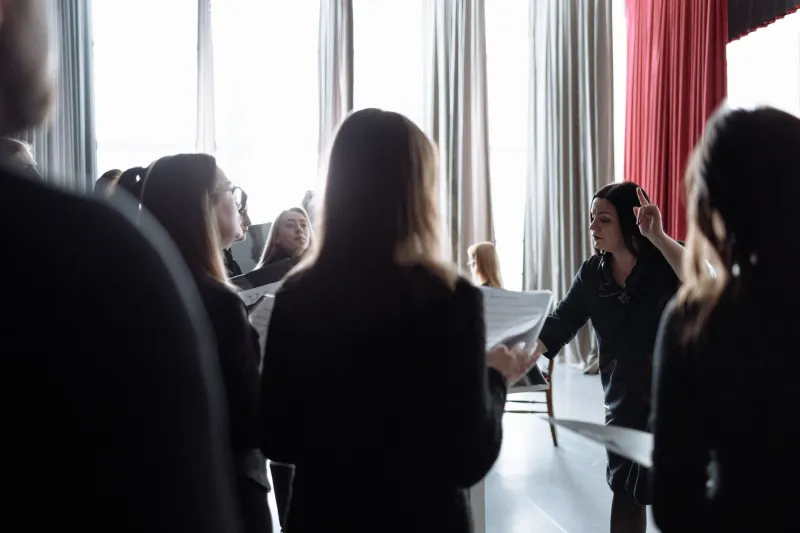
Yet the settings that resonate most strongly in Britain and Ireland are choral. In 1990, British composer Jonathan Dove wrote settings of Heaney for voices; the poet's Sweeney Astray — his translation of the mad medieval king — inspired works precisely because its protagonist was, in effect, a bird-man, a figure halfway between speech and song. The Sweeney material has attracted composers repeatedly: a figure who flies and sings, cursed into music, was simply too apt an emblem to resist.
Northern Irish composers have led the way. Philip Hammond and, most notably, the late John Buckley and Deirdre Gribbin have all drawn on Heaney texts, while the poet's collaboration with the Irish chamber ensemble and with film composers — including his Oscar-nominated lyric "The First Song" for The commitments-era Irish cinema, and later the elegiac music written around his words for the documentary Out of the Marvellous — demonstrated how naturally the poems moved into sound design and score.
A Composer's Dilemma: What to Leave Out
The challenge, composers consistently report, is subtraction. Heaney's poems are complete sonic objects; the composer must resist simply doubling the rhythm with a drum kit. Setting "The Rain Stick" — a poem built on a single cascading sentence — risks illustrating what the poem already enacts. The successful settings tend to slow the verse down, allowing harmony to do what the eye does silently: linger.
There is also the question of the poet's voice itself. Heaney's own recordings, many held in archives and increasingly available online, are so distinctive — the deliberate Ulster vowels, the pauses like furrows — that composers must decide whether to evoke or avoid that voice. The best settings treat it as a presence to be answered, not imitated.
A Listening Guide for UK Audiences
For those wishing to hear Heaney's afterlife in music, the following recordings offer a route in:
- "The Keeners" and choral settings in the Sweeney Astray tradition — the medieval Irish mad-king material has generated the richest seam of vocal music, much of it recorded by Irish and British chamber choirs and available through the usual streaming platforms.
- American song cycles — composers including John Harbison and David Lang have set Heaney texts; search for cycles pairing him with Yeats and Kavanagh to hear the contrast in how composers treat Irish vowels.
- Film and documentary scores — Out of the Marvellous, the 2010 documentary broadcast on BBC, pairs the poet's readings with specially commissioned music, and remains the most accessible single entry point.
- The poet's own recordings — the Faber audio editions and the archive of Heaney's readings at Harvard and Oxford, portions of which are held by the British Library's sound archive, are the essential baseline against which every setting should be heard.
Words That Keep Their Balance
Heaney once wrote that he wanted his poetry to be "handy" — capable of being carried, used, held. Composers have taken him at his word. In their settings, the poems do not become songs so much as reveal that they were always approaching song, the way a ploughed field approaches a landscape painting. For the British listener, hearing Heaney set to music is not a supplement to the reading experience; it is the reading experience, continued at a different tempo.