Spoken Aloud: How Seamus Heaney's Verse Found Its Way onto the Stage
A Poet Who Wrote for the Ear
There is a reason actors keep returning to Seamus Heaney. His lines sit comfortably in the mouth: weighted, cadenced, built from the sounds of speech rather than the abstractions of the page. It is little wonder that British and Irish theatre-makers have spent decades translating his verse into live performance, whether through fully staged productions, dramatic readings, or premieres of work written expressly for the stage.
Heaney himself understood the performative dimension of poetry. He often described his early ambitions in terms of sound — the 'music' he heard in the speech of his Ulster upbringing. That oral quality is precisely what makes his work so teachable, so recitable, and, as this archive has argued before, so rewarding to hear in the poet's own recordings. It is also what makes it theatrical.
The Cure at Troy: Verse Drama in the Modern Age
The clearest example remains The Cure at Troy, Heaney's 1990 version of Sophocles' Philoctetes, written for the Abbey Theatre in Dublin. Commissioned a quarter-century before his death, it became one of the most quoted works in modern Irish public life — not least the famous 'once in a lifetime' passage, recited at political gatherings on both sides of the Atlantic and even borrowed by Nelson Mandela.
The piece demonstrated something important: Heaney could write for actors without losing the density of his poetry. The chorus speaks in verse that is unmistakably his — bog-dark imagery, etymological play, the pull of the past on the present — yet it moves at the pace of drama. Directors staging the work in Ireland and Britain have repeatedly noted the same challenge: resisting the temptation to let the poetry 'float' free of the story. The verse must be spoken as speech, with the meaning arriving before the music.
Readings as Performance
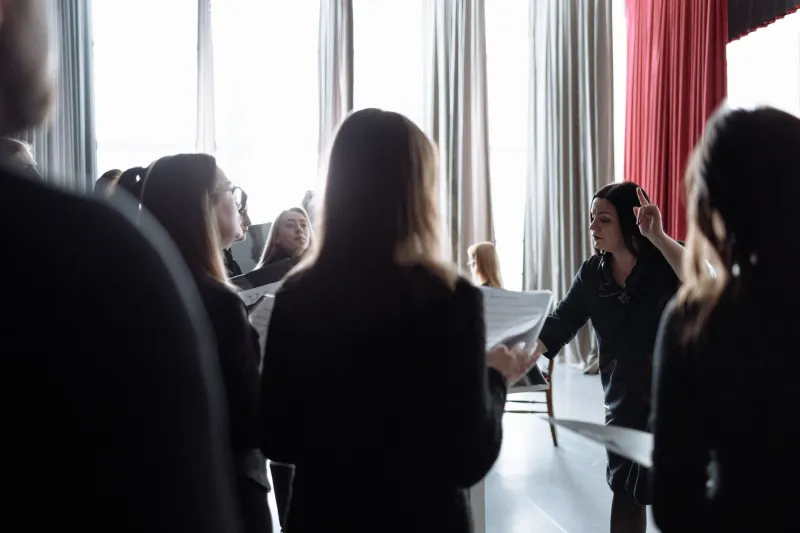
Beyond formal drama, Heaney's work has thrived in a looser theatrical form: the staged reading. Memorial events following his death in 2013 — at Westminster Abbey, in Dublin, and at venues across Britain — treated his poems as texts to be performed by actors and public figures alike. Performers as varied as actors from the Royal Shakespeare Company and leading British poets took up the task, each discovering the same thing: Heaney's poems reward a speaker who trusts plainness.
His own delivery was famously understated. He read without histrionics, letting the internal music carry the emotional weight. Actors who have performed his work often describe a discipline in that approach — the temptation to 'perform' the poem must be resisted. The Famine-era grief of 'At a Potato Digging' or the quiet devastation of 'Mid-Term Break' collapse under melodrama; spoken plainly, they devastate.
Why the Poems Travel to the Stage
Several qualities make Heaney's verse unusually stage-ready:
- Narrative impulse. Many of the poems are stories — a father and grandfather digging, a funeral, a punishment from the bog. Narrative is the theatre's native currency.
- Direct address. Poems such as 'Digging' and 'Follower' speak to and about others, creating an implicit relationship between speaker and listener that actors can inhabit.
- Sound structure. The dense alliteration and assonance of his Ulster-inflected lines give performers something to hold onto rhythmically, in the way verse drama always has.
It is no coincidence that Heaney's version of Beowulf, discussed at length in this archive's translation resources, reads so fluently aloud — he tested much of it against his own voice before it ever reached the page.
A Living Stage Tradition
The tradition continues. Anniversary readings, festival performances at venues from the Southbank Centre to the Ulster Hall, and school and university productions across the UK keep Heaney's work in circulation as performance literature. For educators, staging a poem — even informally, in a classroom — remains one of the most effective ways of teaching students to hear what Heaney called the 'guttural muse' of his home ground.
The poems were, in the end, made of breath. It is fitting that the stage, that oldest home of the spoken word, has become one of the places where they live most fully.